Saturday, November 15, 2014

Jesus Freaks by D.C. Talk


Jesus Freaks
by
d c Talk

Doubts plague Christians. That's how it ought to be. No Christian ever meets the God Jehovah or his son Jesus Christ on earth, and doubt often raises its dreary head. Faith can collapse in what the author describes as "a world of free will rather than God's Will." It's hard to stay Christian in a world with so much debate about free will. If you have God and/or Jesus in your heart, then God and/or Jesus is everywhere, but if you don't, they just don't exist. Most Christians get a little prickly about that obvious thing, but is it any wonder that a crisis of faith occurs in many?

So, the author insists, "we must be freaks."  Jesus Freaks is a book designed to accompany the author's Christian Rock music, and despite that connection, it delivers an amazing antidote to the doubt issue. It refrains from throwing facts and arguments at the skeptic and instead, focuses on faith. With engaging stories of martyrs in Christian history, Jesus Freaks presents examples of Christians who have never wavered in their belief, never given up on God even when threatened with death. If you're a Christian, you'll find this book a god-send. The most shocking tales end with actual martyrdom, accounts that bring tears to the eyes. That's where the title comes from: The book is chock-full of outstanding Jesus freaks.

Saturday, November 8, 2014

The Fiery Trial by Eric Foner

The Fiery Trial
by
Eric Foner


http://www.amazon.com/The-Fiery-Trial-Abraham-American/dp/039334066X/ref=tmm_pap_title_0?ie=UTF8&qid=1415067616&sr=8-1


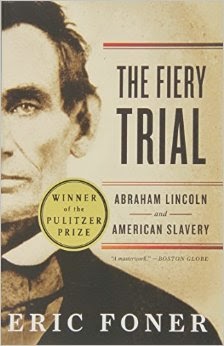
We don't label Abe Lincoln an abolitionist even though abolishing slavery was his existential moment -- because he didn't act like John Brown. By emancipating the slaves, Lincoln became not only the country's biggest abolitionist, but also, as Eric Foner points out in The Fiery Trial, a deity. A book like this, that examines Lincoln's flawed view of African-Americans, offers a realistic and instructive view of Abe Lincoln and his Presidency.

This biography is as wide-reaching as it is fascinating. Foner creates a snapshot of America in the 1860s, and focuses on Lincoln's role in remedying the Nation's biggest blemish. It not only examines Lincoln's anti-slavery past, but also argues that the world we know after the Civil War was strongly influenced by Lincoln and other leaders who chartered separate, though undefined, paths for the country's black and white populations. Their example created troubles for generations.The state of race relations in America for the next 100 years was set in stone even while emancipation became law. The very language Lincoln and his colleagues used, that the author documents throughout the book, remained the language of race relations in America up until the Civil Rights movement in the 1960s.

The author examines Lincoln's opinion slavery and African Americans starting with his young adult years, when Abe experienced life as an indentured laborer in service to his father, right up to his second inauguration and assassination. Lincoln, the author finds, understood the injustice of slavery, but not the humanity of the slaves and not their equality as human beings until the months before the assassination. The author struggles to reconcile Lincoln's paradoxes, or indeed, the similar paradox of slavery in a free democracy. In many ways, Lincoln seems as mediocre as the people around him, not the heroic figure he became when he brought forth the Emancipation Proclamation. Lincoln was both a political pragmatist and a visionary, imagining a nation without slavery, the obstacle course he faced to abolish slavery, and the question the author raises frequently: The future of the newly freed slaves.

While Foner presents Lincoln to his readers as a lawyer more concerned about law and the great potential that America as a nation had yet to realize, there lurks in his account a fellow with a shrewd understanding of how badly things can go wrong in a fledgling democracy. Slavery was the biggest threat to American Democracy because it caused lawless, mob activity like lynchings and the destruction of property. Foner presents a Lincoln not as a politician using this perception as a convenient excuse for abolishing slavery but as a heart-felt conviction that America could not survive the horrible institution.

Abolitionists were disappointed with Lincoln's compromises. While the author lauds Lincoln's political maneuvering, he finds Lincoln's experience of African-Americans lacking, the kind of experience that comes from working with them. Unfortunately, Lincoln evolved from a separatist point-of-view to a more enfranchising one too late in life, and the process of evolution is slow. America had a long way to go after the Emancipation Proclamation to leave racism behind. Lincoln's death, the author argues, severed the country's transition. Had Lincoln lived, his leadership in his second term may have resulted in a healthy assimilation, both with policy-making and by his example.


The violence that happened during reconstruction sort of begs the question, was Lincoln right? Did abolishing slavery restore the rule of law? A reading of the book may convince you that Lincoln and his colleagues could have set a better example and perhaps avoided the violence of the racial conflicts that followed.

Can an abolitionist be a racist? The book suggests that Lincoln eventually judged one could not, but was assassinated before he could turn his newly discovered truth into public policy.    

Thursday, September 18, 2014

Red Mist by Patricia Cornwell


by
Patricia Cornwell


Spoiler alert level: medium

Patricia Cornwell’s novel, Red Mist is a page-turner.

Usually, Cornwell’s detective, Kay Scarpetta, hits her stride when all the evidence is wrong and more important evidence has been overlooked, ignored or misinterpreted. Conflicts with police officers, politicians, criminal attorneys and private investigators pales in comparison.
.
However, in Red Mist, Scarpetta’s conflict with her fellow investigators becomes a significant hurdle she must clear before she can solve the bigger puzzle. Her lesbian niece, Lucy, and Lucy’s lover, Manhattan attorney, Jaime Berger, pull Kay in different directions and the results are disturbing, even fatal.

Early on, Jaime hoodwinks Scarpetta into working for the Innocents Project to free a mentally retarded teenager from Death Row. Jaime of the New York District Attorney’s office, switches sides when newly discovered DNA evidence appears to exonerate mentally retarded girl, Lola, for the gruesome murder of a wealthy Savannah family. As the story begins, Scarpetta knows the State of Georgia scheduled the execution for Halloween but she has nothing to do with the case.

Jaime’s ploy to involve the Brilliant Scarpetta in Savannah eventually exposes everyone to great danger. Scarpetta's involvement angers and worries some pretty powerful bad guys. Cornwell’s scenes between Jaime and Scarpetta crackle with the conflict of a personality war: Scarpetta, who doesn’t understand why she’s being dragged into the Death Row case, imagines the craziest possibilities; and Jaime, who’s goal is like a moving target, misleads and manipulates Scarpetta repeatedly. The conflict is above average for this genre and makes Red Mist hard to put down.

Jaime has becomes something of an DNA-chasing lawyer since Scarpetta last encountered her. In addition, Lucy, a brilliant, self-made millionaire and computer genius is gyrating out of orbit because of the broken relationship with Jaime. The lovers break up when Jaime suffers symptoms of a social death because of her sexual orientation. Despite this potboiler stuff, the story stays away from cheap melodrama for the most part, though Scarpetta gropes for solutions with the existential angst of a nun.

As the main conflict comes into focus, it’s clear Scarpetta faces not one, but a horrifying collaboration of villains who want to see Lola executed, and threaten to form a bizarre triangle to thwart Scarpetta's efforts to discover the truth. Indeed, they appear to be much smarter than Scarpetta’s crew.

First, there's Kathleen Lawler, the mother of the brilliant and murderous Dawn Kincaid, who offers information to Kay of a dead associate, Jack Fielding. Dawn Kincaid and her mother alone would be a handful for an entire law enforcement agency, but Cornwell also brings in the warden of the Georgia Prison for Women, Tara Grimm, who loathes the idea of Lola escaping the lethal injection. In the swamps of coastal Georgia, something is indeed rotten. Completely miffed by Jaime’s manipulations, Scarpetta misses important clues and incidents that later have dire consequences.

In Red Mist, Cornwell treats readers to a number of locked door mysteries, impossible crimes, Terrifying suspects out of time and place, and scientific mysteries that followers of the genre will delight in. For fans of the series, Cornwell also kills off an important, recurring character.

The story’s not without flaws. The retarded girl has clearly been set up for a gruesome, complicated murder, and its unlikely the entire state of Georgia would believe any of the State's claims. And Cornwell’s villains are highly educated people with such tremendous potential, maybe too much to believe they are so completely evil. Moreover, Scarpetta and her company exhibit such super human qualities, you may wonder where their tights and capes are.

Red Mist is such a page-turner, you may be tempted to jump ahead to the ending. It’s not hard. You only need to read one word to unravel the book’s central riddle, but you’ll regret finding it.

This may be the first Scarpetta novel to get a major Hollywood actor, Angelina Jolie, to commit to playing Scarpetta. It’s tough to imagine anybody playing a character that seems so autobiographical (despite Cornwell’s declaration otherwise). Cornwell’s the best person to play Kay Scarpetta. Too bad she doesn’t act. Other actors who would work? Diane Lane or Elizabeth Banks. As for supporting characters: Jaime should be played by Selma Blair. Lucy should be played by, say, Natalie Portman. Now that's an expensive cast. Any suggestions?


Friday, July 25, 2014

In the Garden of the Beasts by Erik Larson

http://www.amazon.com/In-Garden-Beasts-American-Hitlers/dp/B00ES29DMM/ref=sr_1_2?ie=UTF8&qid=1406994662&sr=8-2&keywords=In+the+garden+of+beasts


In the Garden of the Beasts
by
Erik Larson


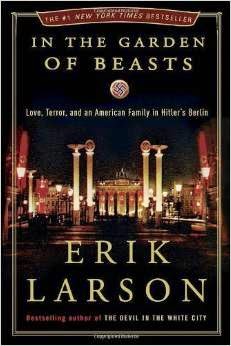
Though Erik Larson mentions in passing the colorful Nazi pageant ("we only see it in black and white war films"), it's at the heart of his book, In the Garden of the Beasts. Larson examines the four years in Berlin from 1933, when W. E. Dodd, formerly a professor of History at University of Chicago, became the American Ambassador to Germany. The book tells Dodd's story to 1937 when America's foreign service corps, an old boy's club, ran Dodd out of town.

Larson lays out the colorful spectacle of Berlin in 1930s, with flower lined streets, exciting cars, the fast trains, terrified Jews, scheming foreign service people, alarmed media, and of course, Nazi thugs. Larson's locations are the government and embassy buildings around the famous Tiergarten, Berlin's enormous central park. This exceptional neighborhood is the setting for the Night of the Long Knives that serves as the book's penultimate, barbaric moment. The urban wonders of Berlin that Larson describes suggest that, at least in the past, Germany could behave better than it did when Dodd was ambassador.

Larson's book focuses on Dodd and his attractive adult daughter, Martha. The author's attention to a small town SS parade that features a shaved and placarded woman who took a Jew as a lover is intended to show how shocking the Nazi movement was to his ingénue, Martha, who witnessed the spectacle. Certainly, if Martha Dodd had been the ideal Joan of Arc type that Larson suggests, her reaction to Nazism and her descent into the world of spies and espionage may have been compelling. Unfortunately, Martha's story is presented as gossipy melodrama, and she and her lovers seem inconvenienced only by a world that puts out young lovers. 

Dodd ambassadorship, on the other hand, is a cautionary tale about a man who recognized Hitler's master plan, but finds his warnings to FDR are ineffective. To Dodd, the Nazi problem seemed so easily fixed in 1934. Unfortunately, America's corrupt diplomatic corps obstructed his efforts. Though Dodd warns of the growing danger Hitler represents, his peers pooh-pooh his concerns. In a sad moment, the State Department suggests Dodd should quit insulting the German government.

America after the Great War was on the rise but Americans didn't appreciate Europe's old order. During the years of Dodd's ambassadorship, Hitler set up the pieces from the Great War in order to fight it over again, and he went ahead like a man confident that he was alone on the playing field. The book's concern is Berlin. The invading Russians reduced the city to rubble in 1945. Larson includes a picture of the Tiergarten after the Russians arrived, reduced to a scorched field. Berlin is a metaphor for Europe. All the adults quit and Hitler had no qualms about destroying it.

Thursday, July 24, 2014

The Various Haunts of Men

The Various Haunts of Men
By
Susan Hill
A Review

Nobody is safe in a Susan Hill novel. Her gothic stories supply answers to her desperate protagonists, but in the end, the riddles are insoluble and the horror is inexorable. So, when Hill takes up the traditional detective novel, the middle-class security blanket, is she really going to make readers warm and fuzzy?

With The Various Haunts of Men, Hill introduces CID Simon Seerailler. She yokes the CID up with a subordinate, DS Graffam in the little town of Laffeter, but the pairing is so unlike say, Elizabeth George's Inspector Thomas Lynley and Sergeant Barbara Havers, there's something amiss, most definitely. Will this arrangement actually survive the book? In fact, DS Graffam, whose only interaction with Seerailler is to occasionally update him on her work, does all the investigating, and Seerailler only steps in at the end.

Graffam, the investigating officer in a missing persons case, is new to the town and utterly lonely. She's gone through a trying divorce and pines for a new life/love. Seerailler immediately strikes her as a potential lover, but she's too frightened to hit on her superior. She stews in silence with her girlhood crush. Seerailler has lived in the village all his life. He comes from a family of medical doctors. The black sheep in the family, he makes a living at his second love, police work, but his first love is art. Graffam, with her debilitating crush, is at the center of the book, setting up an odd, tragic story. The author gives interesting accounts of the victims and a fair amount of space to her creepy killer too.

As the number of missing women increases, Graffam becomes convinced that a serial killer is at work. The first two missing women are oddballs, single for their own reasons; their eccentric lifestyles make them of little interest to the police. Only Graffam and the missing women's friends suspect foul play, and Graffam wishes she could find more evidence to raise a general alarm.

As the serial killer takes another victim, the author sets up Seerailler's professional medical family against a bevy of New Age Health gurus, alternative medicine practitioners and psychics, and entertains us with a phony séances and a district full of New Age retailers with strange products for sale. Seerailler's sister, a doctor in the area, suspects something terrible has happened to one of her patients, and unaware of Graffam's investigation, starts her own, with a head full of significant generalizations about any practice not sanctioned by the medical community.


http://www.amazon.com/The-Various-Haunts-Men-Serrailler/dp/1590200276/ref=sr_1_1?ie=UTF8&qid=1406224177&sr=8-1&keywords=various+haunts+of+men

The mystery keeps you reading. A great twist at the end is worthwhile. Setting her story in a cathedral town might be closer to Hill's gothic novels. It recalls RM James stories, where black, moody monsters live in every nook and cranny. Through Simon Seerailler, Hill manages to bring the quirks and nuances of the little village to light, although the pursuit of a maniacal killer whose gruesome acts appall the community are unquestionably part of the police procedural genre.