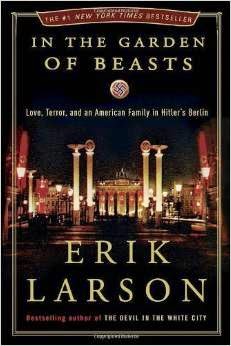
In the Garden of the Beasts
by
Erik Larson
Though Erik Larson mentions in passing the colorful Nazi pageant ("we only see it in black and white war films"), it's at the heart of his book, In the Garden of the Beasts. Larson examines the four years in Berlin from 1933, when W. E. Dodd, formerly a professor of History at University of Chicago, became the American Ambassador to Germany. The book tells Dodd's story to 1937 when America's foreign service corps, an old boy's club, ran Dodd out of town.
Larson lays out the colorful spectacle of Berlin in 1930s, with flower lined streets, exciting cars, the fast trains, terrified Jews, scheming foreign service people, alarmed media, and of course, Nazi thugs. Larson's locations are the government and embassy buildings around the famous Tiergarten, Berlin's enormous central park. This exceptional neighborhood is the setting for the Night of the Long Knives that serves as the book's penultimate, barbaric moment. The urban wonders of Berlin that Larson describes suggest that, at least in the past, Germany could behave better than it did when Dodd was ambassador.
Larson's book focuses on Dodd and his attractive adult daughter, Martha. The author's attention to a small town SS parade that features a shaved and placarded woman who took a Jew as a lover is intended to show how shocking the Nazi movement was to his ingénue, Martha, who witnessed the spectacle. Certainly, if Martha Dodd had been the ideal Joan of Arc type that Larson suggests, her reaction to Nazism and her descent into the world of spies and espionage may have been compelling. Unfortunately, Martha's story is presented as gossipy melodrama, and she and her lovers seem inconvenienced only by a world that puts out young lovers.
Dodd ambassadorship, on the other hand, is a cautionary tale about a man who recognized Hitler's master plan, but finds his warnings to FDR are ineffective. To Dodd, the Nazi problem seemed so easily fixed in 1934. Unfortunately, America's corrupt diplomatic corps obstructed his efforts. Though Dodd warns of the growing danger Hitler represents, his peers pooh-pooh his concerns. In a sad moment, the State Department suggests Dodd should quit insulting the German government.
America after the Great War was on the rise but Americans didn't appreciate Europe's old order. During the years of Dodd's ambassadorship, Hitler set up the pieces from the Great War in order to fight it over again, and he went ahead like a man confident that he was alone on the playing field. The book's concern is Berlin. The invading Russians reduced the city to rubble in 1945. Larson includes a picture of the Tiergarten after the Russians arrived, reduced to a scorched field. Berlin is a metaphor for Europe. All the adults quit and Hitler had no qualms about destroying it.

