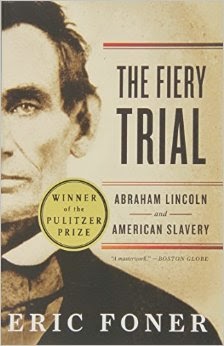
The Fiery Trial
by
Eric Foner
We don't label Abe Lincoln an abolitionist even though abolishing slavery was his existential moment -- because he didn't act like John Brown. By emancipating the slaves, Lincoln became not only the country's biggest abolitionist, but also, as Eric Foner points out in
The Fiery Trial, a deity. A book like this, that examines Lincoln's flawed view of African-Americans, offers a realistic and instructive view of Abe Lincoln and his Presidency.
This biography is as wide-reaching as it is fascinating. Foner creates a snapshot of America in the 1860s, and focuses on Lincoln's role in remedying the Nation's biggest blemish. It not only examines Lincoln's anti-slavery past, but also argues that the world we know after the Civil War was strongly influenced by Lincoln and other leaders who chartered separate, though undefined, paths for the country's black and white populations. Their example created troubles for generations.The state of race relations in America for the next 100 years was set in stone even while emancipation became law. The very language Lincoln and his colleagues used, that the author documents throughout the book, remained the language of race relations in America up until the Civil Rights movement in the 1960s.
The author examines Lincoln's opinion slavery and African Americans starting with his young adult years, when Abe experienced life as an indentured laborer in service to his father, right up to his second inauguration and assassination. Lincoln, the author finds, understood the injustice of slavery, but not the humanity of the slaves and not their equality as human beings until the months before the assassination. The author struggles to reconcile Lincoln's paradoxes, or indeed, the similar paradox of slavery in a free democracy. In many ways, Lincoln seems as mediocre as the people around him, not the heroic figure he became when he brought forth the Emancipation Proclamation. Lincoln was both a political pragmatist and a visionary, imagining a nation without slavery, the obstacle course he faced to abolish slavery, and the question the author raises frequently: The future of the newly freed slaves.
While Foner presents Lincoln to his readers as a lawyer more concerned about law and the great potential that America as a nation had yet to realize, there lurks in his account a fellow with a shrewd understanding of how badly things can go wrong in a fledgling democracy. Slavery was the biggest threat to American Democracy because it caused lawless, mob activity like lynchings and the destruction of property. Foner presents a Lincoln not as a politician using this perception as a convenient excuse for abolishing slavery but as a heart-felt conviction that America could not survive the horrible institution.
Abolitionists were disappointed with Lincoln's compromises. While the author lauds Lincoln's political maneuvering, he finds Lincoln's experience of African-Americans lacking, the kind of experience that comes from working with them. Unfortunately, Lincoln evolved from a separatist point-of-view to a more enfranchising one too late in life, and the process of evolution is slow. America had a long way to go after the Emancipation Proclamation to leave racism behind. Lincoln's death, the author argues, severed the country's transition. Had Lincoln lived, his leadership in his second term may have resulted in a healthy assimilation, both with policy-making and by his example.
The violence that happened during reconstruction sort of begs the question, was Lincoln right? Did abolishing slavery restore the rule of law? A reading of the book may convince you that Lincoln and his colleagues could have set a better example and perhaps avoided the violence of the racial conflicts that followed.
Can an abolitionist be a racist? The book suggests that Lincoln eventually judged one could not, but was assassinated before he could turn his newly discovered truth into public policy.